By Nathan Kiwere
When that first ray of the gospel flashed on the coast of the African continent, they did not progress through the magnificent cathedrals or the theological seminaries of the West, but through humble men and women whose hearts burned with an enduring and unbreakable faith. These original African evangelists, little recognized and sometimes nameless, were the pioneers who spiritually broke the ground on the continent before the structures of organized Christianity were in position. Their devotion, fidelity, and sacrifice were the pillars on which the living African church exists now.
In the early decades of Christianity’s meeting with Africa, missionary societies from Europe arrived with enthusiasm to propagate the gospel. But it was the Africans who received the message, digested it, and then carried it far beyond the intent of the foreign missionaries. The early church in Africa is thus not so much a history of missionary enterprise—it is, more essentially, a history of indigenous transformation. Once converted, the original believers were transformed into missionaries to their own people, oftentimes walking great distances across forests, grasslands, and river bottoms to disseminate the new religion.
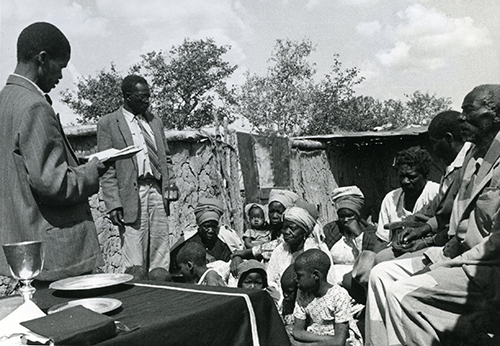
Imagine a barefoot preacher walking through the middle of the day, a tiny Bible folded in cloth under his arm. With no pay and no formal rank, he trudged from village to village, sleeping in the shade of mango trees or by wells where throngs gathered. There he would read aloud the words of Scripture from newly translated tongues in foreign lips, expounding the mysteries of faith in terms of parables and stories of everyday experience. When he prayed for the sick, people listened. As he sang the hymns he had learned from the missionaries but now in local rhythm and tone, others joined him. Slowly, the gospel began to take root in African soil—not as an imported religion, but as a known one.
The early missionaries wrestled horribly. Sometimes they were rejected by their own community as individuals who had abandoned conventional practices. Some of them wrestled with poverty, sickness, and even jail due to their faith. Yet they persevered, motivated by an inner conviction that they were being summoned to a higher calling than their own. They were not scholarly theologians, but they possessed a theology of the heart—an experiential understanding of God that spoke directly into the African heart.
A classic example is in the spread of Christianity into East and Central Africa’s interior regions. Only after the foreign missionaries had taken root in coastal or urban regions did native believers advance into the interior recesses, planting small prayer fellowship groups that matured into full congregations. They built simple chapels of mud and thatch, where worship involved drumming, singing, and testimony. These gatherings became not only the centres of religion but of education and social reform as well. The majority of the great churches and Christian schools of today trace their origins back to such humble beginnings.
Elsewhere on the continent, in the west and south, revival had been spurred by the courage of African priests who resisted colonial occupation and moral decay. Their oneness sparked awakenings that swept across borders and brought thousands to Christianity. They were visionaries who believed God’s power was not an exclusive domain of the Western world but a living force in Africa too. Their prophetic words broke the chains of inferiority that had dragged down the African mind for so long, and there arose a glorious, Spirit-grafted church that spoke in its own voice.
Their heritage is visible today in the dynamic congregations that pour through our cities and villages, in the broadcast radio signals that stream gospel messages in dozens of local languages, and in the universities and seminaries that are “nurseries” for the next generation of pastors. Modern African Christianity—with its dynamic worship, deep spirituality, and civic engagement—is a direct result of those pioneer missionaries who sowed in tears so others may reap in joy.
And if the church today stands so tall and proud as it does, it is because it stands on the shoulders of these pioneers who dared to believe the good news could take root on African soil. Their legacy is a great reminder that once sown, faith can penetrate language, culture, and time barriers. They did not wait for ideal circumstances or imposing cathedrals. They preached in bazaars, prayed in huts, and baptized in rivers. And through their adherence, the seed of Christ grew to become a robust tree now shielding millions on the continent.
As we pay tribute to the ministry of today’s African Christian leaders—pastors, missionaries, theologians, and evangelists—it is vital that we catch a glimpse backward at those trailblazing men and women who blazed the trail for us. Their tread, though faint on the dusty pathways of history, still leads us ahead. They were God’s African generals before the name was ever coined—loyal soldiers of the cross who transformed Africa, soul by soul.
Leave a Reply